The architecture and the glass
Blue glass and an octagon: Eiermann and Loire
How Egon Eiermann's octagonal Memorial Church and Gabriel Loire's hand-cast blue glass walls were made, and what the double wall does for the room.
Reserve your seat for the concert ↗Quick answer
Egon Eiermann's Memorial Church is an octagon of steel, concrete and glass about 35 metres across. Its walls are concrete honeycomb filled with hand-cast blue glass by Gabriel Loire of Chartres, built as a double wall that shields the room from the city's noise.
An octagon in a steel frame
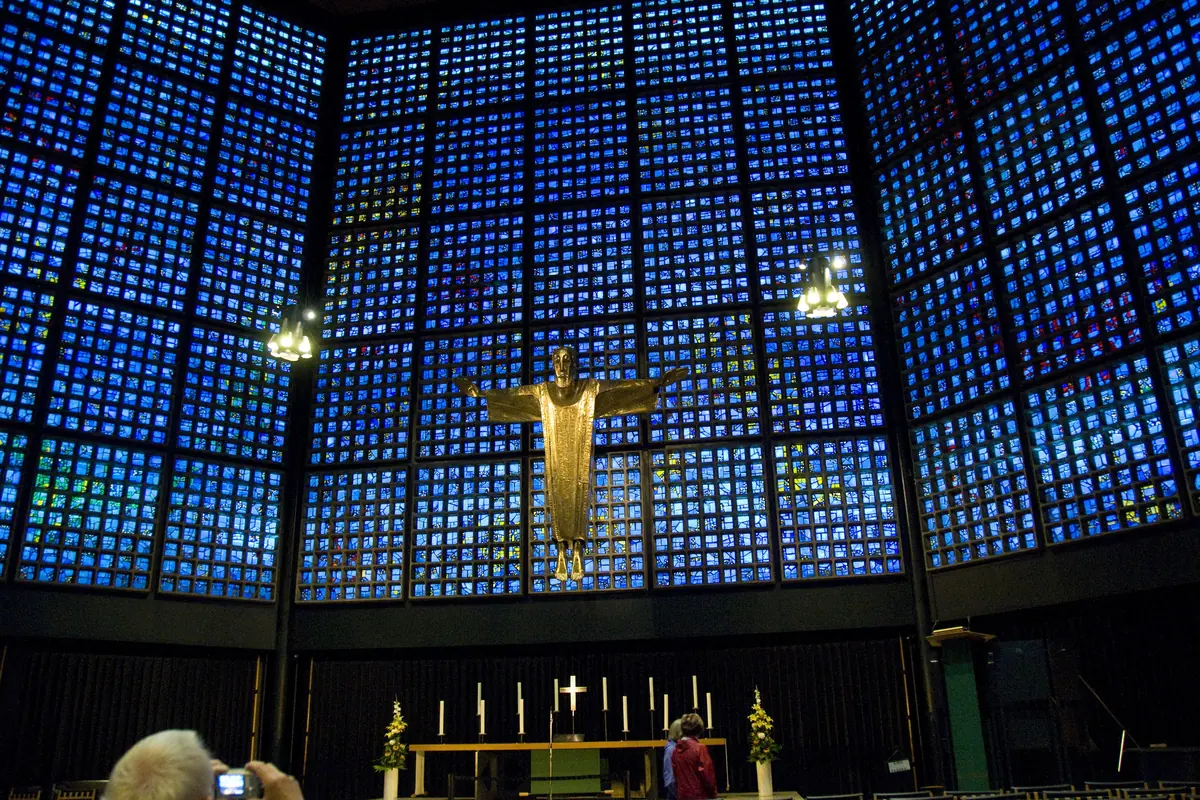
The new church is an eight-sided building about 35 metres across and roughly 20 metres high. A steel skeleton forms its frame, with round steel columns at each corner joined by a grid of horizontal and vertical steel bands. Square fields of concrete honeycomb fill the grid. The lower part of the wall is bricked up, and the much larger upper part carries glass. Eiermann made the construction visible instead of dressing it in decoration, and the church calls the result a radical reduction to the essentials: repeated geometric shapes, repeated materials and a play of light.
Gabriel Loire and the glass
The French glass artist Gabriel Loire, who ran a studio in Chartres, designed and made the windows in 1960 and 1961. He used the technique called dalle de verre: thick slabs of coloured glass are broken into pieces and set in concrete. The church describes the effect as a blue-glowing landscape of thousands of fragments, with small clusters of red, green and yellow. The windows are abstract and carry no figures.
Why the glass is blue
Loire spent many hours in Chartres Cathedral studying how its medieval windows treat colour and light, and its blue is famous. In medieval art deep blue meant the divine and the sky. Loire described the blue of his Berlin windows as standing for peace and the flecks of other colours for joy. The church reads the part played by a French designer as a sign of peace and of German–French reconciliation, and it sees the colour as heavenly as well.
The double wall
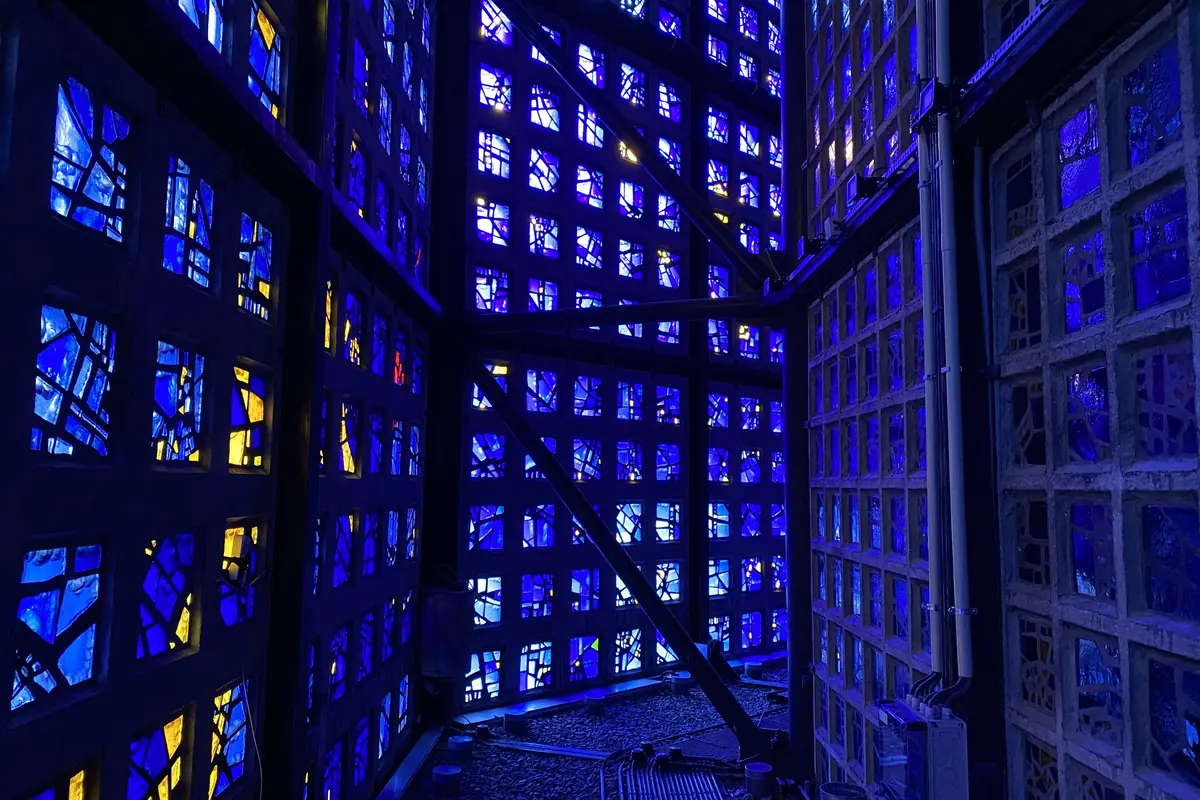
The church is built with two walls, with a passage about 2.4 metres wide between them. The wall you see from outside is not the one you see from inside. The outer wall has its own glass, in larger panes, and the church says the deep blue you see inside in daylight comes mostly from that outer glass. The second wall was mainly meant as sound insulation, so that a glass church in the middle of the city could still be a place of quiet.
Light after dark
Lamps in the passage between the walls shine through the glass after dusk, so the church glows in blue tones into the square. The first lights were spotlights, and since the mid-2010s the church has used many small LEDs that switch on at dusk. The church says the facade glass shows its full luminosity only at night and from inside, which is why the building looks quite different by day and after dark.
Chairs, floor and altar
Eiermann designed the interior as a whole. He chose single chairs with wooden frames and black straps over pews, and the floor is a mosaic of round ceramic and concrete plates. The altar is wood and steel with twelve candlesticks, which recall the twelve tribes of Israel, the twelve disciples and the twelve gates of the heavenly Jerusalem. Above it hangs a figure of the resurrected Christ by Karl Hemmeter, on two thin steel cables.
A building that needs care
After more than 60 years the church is renovating its facades. The reinforcing steel in the concrete honeycombs is corroding and concrete is flaking. The steel wire inside the glass slabs is rusting too, which presses on neighbouring glass and causes cracks. The church's programme of works runs on the facades from 2027, and it says concerts and services continue while the work goes on. For a visitor that means some scaffolding or screening on the facades in the coming years, while the room inside carries on as before.
Sources